
Introduction
You probably started with something like Lovable AI, Bolt.new, or v0 by Vercel. You managed to build app with AI, got a working prototype, maybe even a few users. It feels close. But not launch-ready.
Now you’re stuck in that frustrating last stretch. Payments don’t connect. Auth breaks. APIs don’t behave. The UI looks fine, but the backend feels like duct tape.
This is where most AI apps stall. Not because the idea is weak, but because the AI app builder got you 80% there and the last 20% is real engineering.
Let’s break down what it actually takes to finish, ship, and scale an AI SaaS in 2026.


What Building AI SaaS Really Means in 2026
There’s a misconception floating around: if you can generate code or UI with AI, you’ve “built” the product.
Here’s the reality:
AI app builders help you create prototypes fast. They don’t handle production complexity.
When founders say they want to build app with AI, what they usually mean is:
- Generate UI using tools like v0 by Vercel or Framer AI
- Add logic with Cursor AI or Replit AI
- Plug in APIs using ChatGPT or Claude Artifacts
That gets you a working demo. Not a scalable SaaS.
According to a 2025 report by McKinsey, over 65% of AI-assisted applications fail to reach production due to integration and infrastructure gaps.
So the real definition of “building AI SaaS” is:
Turning an AI-generated prototype into a stable, secure, scalable product that real users can pay for.
And that’s where things get technical.
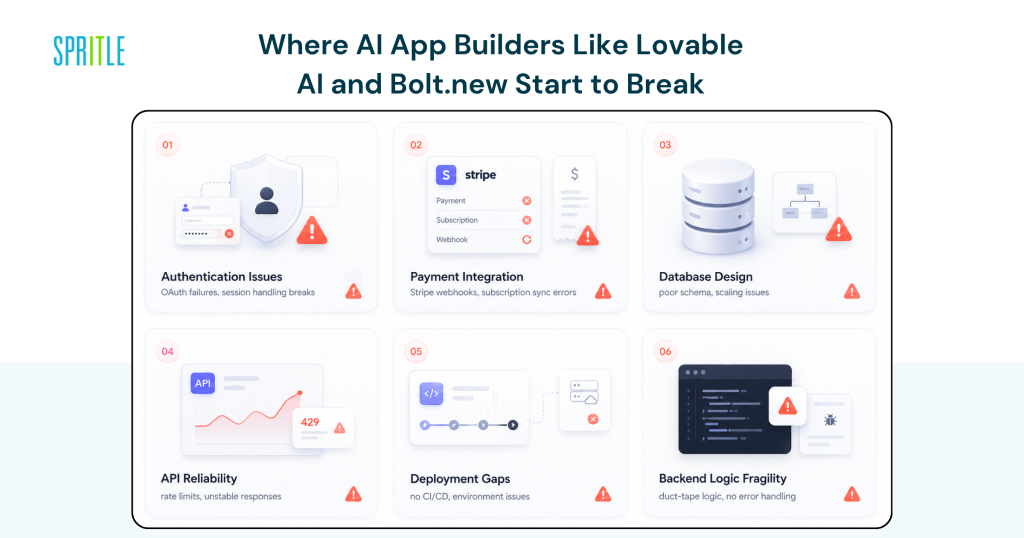
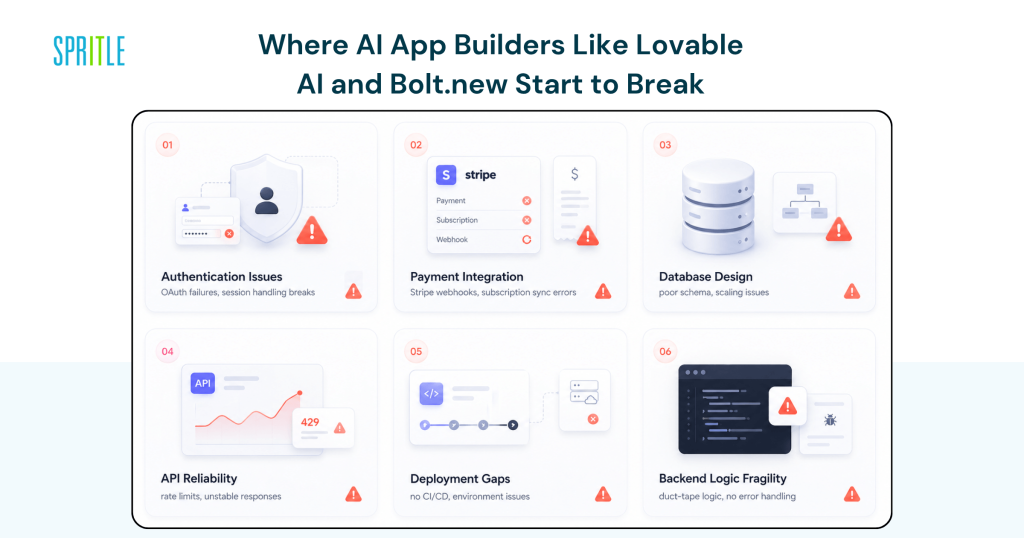
Where AI App Builders Like Lovable AI and Bolt.new Start to Break
AI builders are impressive. No question. But they hit predictable limits.
Here’s where most people get stuck.
1. Authentication and User Management
Tools like Lovable AI or Bolt.new can scaffold login flows. But:
- OAuth (Google, Apple login) often fails
- Session handling breaks under load
- Role-based access isn’t properly secured
This isn’t a UI issue. It’s backend logic.
2. Payment Integration (Stripe, Subscriptions)
You can generate a pricing page easily. But connecting it to Stripe properly?
- Webhooks don’t trigger reliably
- Subscription states go out of sync
- Trial logic breaks
This is one of the most common “fix my AI-built website” requests.
3. Database Design and Scaling
AI tools generate schemas, but they rarely optimize:
- Relationships between tables
- Query performance
- Indexing for scale
A 2024 Stack Overflow survey showed over 58% of developers manually refactor AI-generated database logic before production.
4. API Reliability
AI-generated API calls look clean… until:
- Rate limits hit
- Errors aren’t handled
- Responses change format
Now your app breaks silently.
5. Deployment and Environment Setup
Most AI apps run locally or in sandboxed environments.
Moving to production means:
- Setting up CI/CD pipelines
- Managing environment variables
- Handling cloud infrastructure
This is the part AI builders won’t solve for you.
The Real Cost of Building AI SaaS (What Nobody Tells You)
Let’s talk numbers. Not the “$20/month AI tool” version. The real one.
Phase 1: AI Prototype (What you’ve already done)
- Tools: Lovable AI, Cursor AI, v0
- Cost: $0 – $200/month
- Output: 70–80% complete product
This is the easy part.
Phase 2: Technical Completion (Where things get real)
If you try to DIY:
- Time: 2–6 months
- Cost: Opportunity loss + delayed launch
If you hire freelancers:
- $25–$100/hour
- Inconsistent quality
- Requires technical oversight
If you hire a specialized AI app completion service:
- $3,000 – $15,000 depending on complexity
- Faster turnaround (2–6 weeks)
- Production-ready outcome
Phase 3: Ongoing Infrastructure
- Hosting (Vercel, AWS): $50–$500/month
- APIs (OpenAI, etc.): usage-based
- Monitoring + security tools
What this really means is simple:
The cost of not finishing is higher than the cost of finishing properly.
Every week you’re stuck is lost users, lost feedback, and lost momentum.
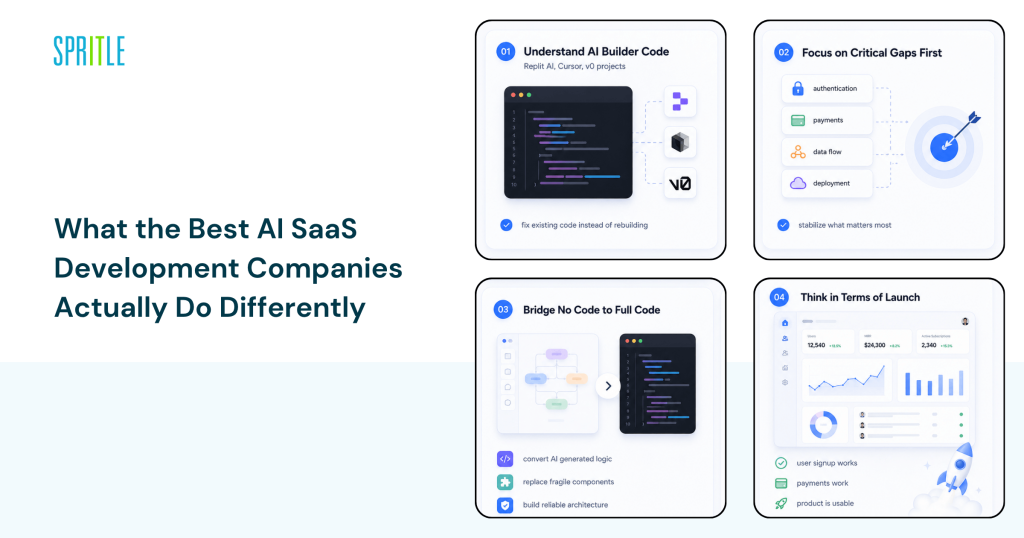
What the Best AI SaaS Development Companies Actually Do Differently
Not all dev teams are equal. Especially in this space.
The best companies don’t rebuild your app. They complete it intelligently.
Here’s what to look for:
They Understand AI Builder Code
They’ve worked with:
- Replit AI projects
- Cursor-generated codebases
- v0 frontends
They don’t start from scratch. They fix what exists.
They Focus on Critical Gaps First
Instead of “improving everything,” they prioritize:
- Authentication
- Payments
- Data flow
- Deployment
That’s how you ship faster.
They Bridge No-Code to Full-Code
This is key.
A good partner knows how to:
- Convert AI-generated logic into maintainable code
- Replace fragile components without breaking your app
- Keep your original vision intact
They Think in Terms of Launch, Not Code
Freelancers often optimize for tasks.
Real teams optimize for outcomes:
- Users can sign up
- Users can pay
- Users can stay
That’s a shipped SaaS.
Real Scenarios: Where Founders Get Stuck (And What Fixing It Looks Like)
Let’s make this concrete.
Scenario 1: SaaS Dashboard Built with v0 by Vercel
You built a clean UI. Everything looks great.
Problem:
- No real backend
- Data is mocked
- No persistence
Fix:
- Connect to a real database (PostgreSQL/Firebase)
- Build API layer
- Add authentication
Outcome:
You go from demo → actual product users can log into.
Scenario 2: AI Writing Tool Built with Replit AI
You’ve got prompt workflows working.
Problem:
- API calls fail under load
- No rate limiting
- Users get errors
Fix:
- Add backend queue system
- Handle retries and failures
- Optimize API usage
Outcome:
Stable experience → users trust your product.
Scenario 3: Coaching Platform Built with Lovable AI
Landing page and signup are done.
Problem:
- Payment flow is broken
- Users can’t access paid content
Fix:
- Integrate Stripe properly
- Sync subscription states
- Protect premium routes
Outcome:
Revenue starts flowing. Finally.
When You Need More Than an AI App Builder
Here’s the honest truth.
AI builders are incredible for starting.
But finishing? That’s a different game.
The teams that ship fastest aren’t the ones who prompt harder. They’re the ones who recognize this moment:
“This isn’t a prompt problem anymore. It’s an engineering problem.”
That’s when bringing in technical help makes sense.
Not to replace what you built.
To unlock it.
This is where hire developer to finish AI app or technical help for AI builders becomes the smartest move—not an expensive one.
What to Avoid When Building AI SaaS in 2026
A few patterns show up again and again.
Avoid these:
1. Over-Prompting Instead of Fixing Architecture
You can’t debug system design with prompts alone.
2. Rebuilding from Scratch Too Early
Your AI-generated code has value. Use it.
3. Hiring Generic Developers
They may not understand AI-generated code structures.
4. Ignoring Security and Data Protection
Especially if you’re handling user data.
5. Delaying Launch for Perfection
Done and live beats perfect and stuck.
FAQ
Q: Can I fully build app with AI without developers in 2026?
A: You can get very close using an AI app builder, but production-level features like payments, security, and scaling still require technical expertise. Most founders need help for the final 20%.
Q: Why do AI apps break during scaling?
A: AI-generated code often lacks proper error handling, database optimization, and infrastructure setup. These issues only appear when real users start using the product.
Q: Should I rebuild my app or fix what I already built with AI?
A: In most cases, fixing and improving your existing AI app is faster and cheaper. A good AI app completion service will reuse your current codebase efficiently.
Conclusion
You’ve already done the hardest part. You took an idea and turned it into something real using AI apps and an AI app builder.
What’s left isn’t magic. It’s engineering.
The gap between your current prototype and a live SaaS product is smaller than it feels. But it does require a shift—from prompting to building properly.
Once you cross that line, everything changes. Users can sign up. Payments work. Growth becomes possible.
And suddenly, it’s not just an idea anymore. It’s a business.