

In today’s AI-driven world, buzzwords like AI, Machine Learning (ML), Large Language Models (LLMs), and Generative AI are everywhere—but often misunderstood. They’re used interchangeably, though each has a distinct role and impact.
In this blog, we won’t just define them in silos. Instead, we’ll pit them against each other, clarify how they’re related, how they differ, and which ones actually matter for your business. Along the way, we’ll drop real-world use cases, analogies, and examples from Shaip’s experience to make it all click.
Start With the Basics: The AI Hierarchy
Think of Artificial Intelligence as the broad umbrella under which Machine Learning is a subset. From ML, we get LLMs and eventually, Generative AI.
Here’s a quick breakdown:
| Technology | Role | Analogy |
|---|---|---|
| AI | The big idea – making machines smart | A smart assistant |
| ML | A method – learning from data | A student learning from examples |
| LLM | Specialized model for language tasks | A language expert |
| Generative AI | Capability to create new content (text, images) | An artist or content creator |
AI vs ML: Parent vs Prodigy
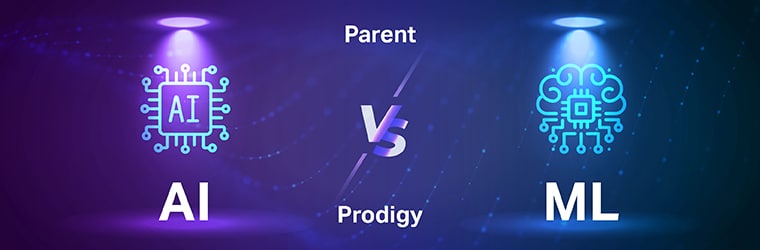
Artificial Intelligence (AI) refers to the broader field of building machines that mimic human intelligence—planning, reasoning, and decision-making. Think of AI as the parent—a vast discipline aiming to make machines act like humans. It spans everything from playing chess to recognizing faces.
Machine Learning (ML) is the prodigy child. ML is a method by which machines learn patterns from data without being explicitly programmed. It’s how AI gets smart—by learning from past data.
Example:
- AI: A self-driving car that uses vision, decision-making, and motion control.
- ML: The algorithm that helps the car learn the best route based on traffic history.
- 🎯 Bottom line: ML is a subset of AI. All ML is AI, but not all AI is ML.
🟡 ML is how AI evolves from a rule-based engine into an adaptive system.
ML vs LLM: General Learning vs Language Mastery

ML covers a wide array of applications—from detecting fraud to suggesting what to watch next.
LLMs are a specialized type of ML model trained on vast amounts of text. They’re designed for language-based tasks like summarizing, translating, and answering questions. They’re trained on massive text datasets to understand and generate human-like language.
LLMs are built using deep learning (a subset of ML) and transformer architectures. They focus specifically on language tasks like summarization, sentiment analysis, and content creation.
[Also Read: What is Multimodal Data Labeling? Complete Guide 2025]
Example:
- ML: Predicting customer churn based on engagement data.
- LLM: Writing a personalized email to a user explaining why they’re getting a discount
- 🎯 Bottom line: LLMs are language-focused powerhouses built on ML. Think of them as language specialists within the AI family.
🟡 LLMs are the “linguists” of the ML world.
LLM vs Generative AI: Structure vs Creativity

Now here’s where things get juicy. Not all LLMs are generative, and not all Generative AI models are LLMs. But many do overlap.
Generative AI refers to any model that can produce original content. This includes language, images, audio, and even code.
LLMs like GPT-4 are often used for generative tasks involving text—but not all generative models are LLMs.
Example:
- LLM: Drafting an email or summarizing a report.
- Generative AI: Creating a product mockup image or synthetic voice-over for an ad.
- 🎯 Bottom line: Generative AI is a function (creation). LLMs are a form (language model). They intersect when an LLM is designed to generate language.
🟡 LLMs = language generation. Generative AI = all kinds of content generation.
[Also Read: Human-in-the-Loop: How Human Expertise Enhances Generative AI]
Quick Tech Showdown: Who Does What?
Here’s a side-by-side comparison of AI, ML, LLM, and Generative AI across real-world use cases: