
Language is complex—and so are the technologies we built to understand it. At the intersection of AI buzzwords, you’ll often see NLP and LLMs mentioned as if they’re the same thing. In reality, NLP is the umbrella methodology, while LLMs are one powerful tool under that umbrella.
Let’s break it down human-style, with analogies, quotes, and real scenarios.
Definitions: NLP and LLM
What is NLP?
Natural Language Processing (NLP) is like the art of understanding language—syntax, sentiment, entities, grammar. It includes tasks such as:
- Part-of-speech tagging
- Named Entity Recognition (NER)
- Sentiment analysis
- Dependency parsing
- Machine translation
Think of it like a proofreader or translator—rules, structure, logic.
What is an LLM?
A Large Language Model (LLM) is a deep learning powerhouse trained on massive datasets. Built on transformer architectures (e.g., GPT, BERT), LLMs predict and generate human-like text based on learned patterns Wikipedia.
Example: GPT‑4 writes essays or simulates conversations.
Side-by-Side Comparison
How They Work Together
NLP and LLMs aren’t rivals—they’re teammates.
- Pre‑processing: NLP cleans and extracts structure (e.g. tokenize, remove stop words) before feeding text to an LLM
- Layered Use: Use NLP for entity detection, then LLM for narrative generation.
- Post‑processing: NLP filters LLM output for grammar, sentiment, or policy compliance.
Analogy: Think of NLP as the sous-chef chopping ingredients; the LLM is the master chef creating the dish.
When to Use Which?
✅ Use NLP When
- You need high precision in structured tasks (e.g., regex extraction, sentiment scoring)
- You have low computational resources
- You need explainable, fast results (e.g., sentiment alerts, classifications)
✅ Use LLM When
- You need coherent text generation or multi-turn chat
- You want to summarize, translate, or answer open-ended questions
- You require flexibility across domains, with less human tuning
✅ Combined Approach
- Use NLP to clean and extract context, then let the LLM generate or reason—and finally use NLP to audit it
Real-World Example: E-Commerce Chatbot (ShopBot)
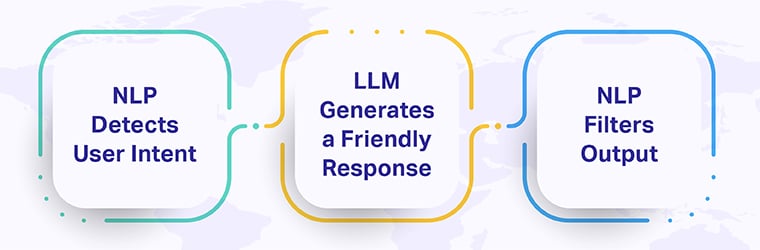
Step 1: NLP Detects User Intent
User Input: “Can I buy medium red sneakers?”
NLP Extracts:
- Intent: purchase
- Size: medium
- Color: red
- Product: sneakers
Step 2: LLM Generates a Friendly Response
“Absolutely! Medium red sneakers are in stock. Would you prefer Nike or Adidas?”
Step 3: NLP Filters Output
- Ensures brand compliance
- Flags inappropriate words
- Formats structured data for the backend
Result: A chatbot that’s both intelligent and safe.
Challenges and Limitations
Understanding the limitations helps stakeholders set realistic expectations and avoid AI misuse.
- NLP Example: A sentiment model trained only on English tweets might misclassify African American Vernacular English (AAVE) as negative.
- LLM Example: A resume-writing assistant might favor male-associated language like “driven” or “assertive.”
Bias mitigation strategies include dataset diversification, adversarial testing, and fairness-aware training pipelines.